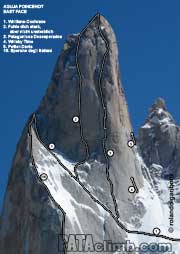
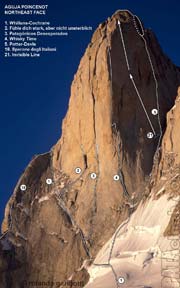
Aguja Poincenot - East face
3. Patagónicos Desesperados
550m 7a+
Daniel Anker and Michel Piola (CH), 9&11/1/1989, in two pieces. Oriol Baro (Cataluña) and Ramiro Calvo (AR) in late 2010 made the first continuos ascent.
Gritty rock in the lower thrid, but fine rock and climbing in the upper two thirds. The first ascent party placed 16 bolts, most of them at belays. The upper part involves steep and sustained climbing, up cracks that are at times wide.
History. The route was climbed alpine style over two days. On the first day the first ascentionists approached the upper 2/3s by climbing the Whillans snow ramp, adding the lower seven pitches two days later.
During that visit Piola and Anker waited for good weather in the Piergiorgio valley for about a month, until they run out of time and had to go home. The day they were supposed to leave they changed their minds, and decided to stay an extra ten days. During those ten days, and in spite of mostly bad weather they climbed four new routes, one on El Mocho, one on Innominata, one on Guillaumet and this impressive one on Poincenot. The name of the article Piola wrote for Mountain Magazine back then was “Patagonicos Desesperados”, a name that likely explains well the frustration they so successfully channeled into such a ferocious spree of activity.
In late 2010 Catalan Oriol Baro and Argentine Ramiro Calvo made the first continuos ascent of the route, linking the bottom and top portions to reach the summit. They bivied once in a small ledge at the end of pitch 6.
Free ascent. In early 2019, Siebe Vanhee (BE) did the first free ascent of the route. One week later, Leanoardo Gheza (IT) did the first onsight ascent.
Approach. Paso Superior and Glaciar Piedras Blancas Superior.
Descent. Rappel via the same route. All belays are equipped with bolts, pins and carabiners for fast retreat. This route is a good descent line for anybody summiting Poincenot and not willing to deal with the slow Whillans descent. The first rap station can be found two meters below the SE end of the main summit.
Bibliography. Mountain Magazine 130 p. 20-25; Vertical magazine 32 p. 28-37; AAJ 1990 p. 206-209.
|