Fitz Roy - South face
26. Anglo-Americana
550m 45˚ 6a A3
Larry Derby (USA), Ian Wade, Guy Lee, Dave Nicol, Eddie Birch, and Julian Anthonie (UK), 11/12/1972.
Description. This route starts just a few meters left of the ruta Francesa. It is a completely independent line that initially follows a prominent wide crack left of the SSE spur. The crack, which is 20 to 50 cm wide is smeared with ice on its upper portion and therefore a thin secondary crack has to be climbed. This involves ten meters of precarious climbing on copperheads and three moves on bat-hooks to gain a jammed block. Another 20 meters of exposed off-width climbing lead to easier terrain and a visible snowfield. A series of difficult ice runnels lead to an obvious brake under overhangs. Here the route traverses left, across loose ice-up terrain to a bomb-bay chimney that is avoided by climbing hairline cracks to the right. A mixed traverse further left leads to the summit slopes. 650m altogether.
History. Their original intention was to climb the east face but upon having a closer look at it, they decided for the less intimidating south face. The route was completed with the use of fixed ropes. It is still unrepeated.
Approach. Paso Superior to Brecha de los Italianos to La Silla (300m 75˚ -to 90˚- 3).
Descent. Francesa.
Bibliography. AAJ 1973 p. 477; Mountain 28 p. 18-21; Rucksack Club Journal 1973/65 p. 1-16. |
Photos (click to enlarge)
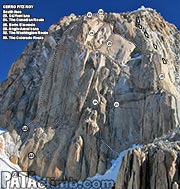
Fitz Roy south face 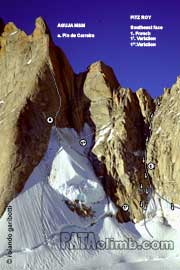
Brecha east face
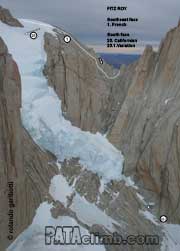
Brecha west face |